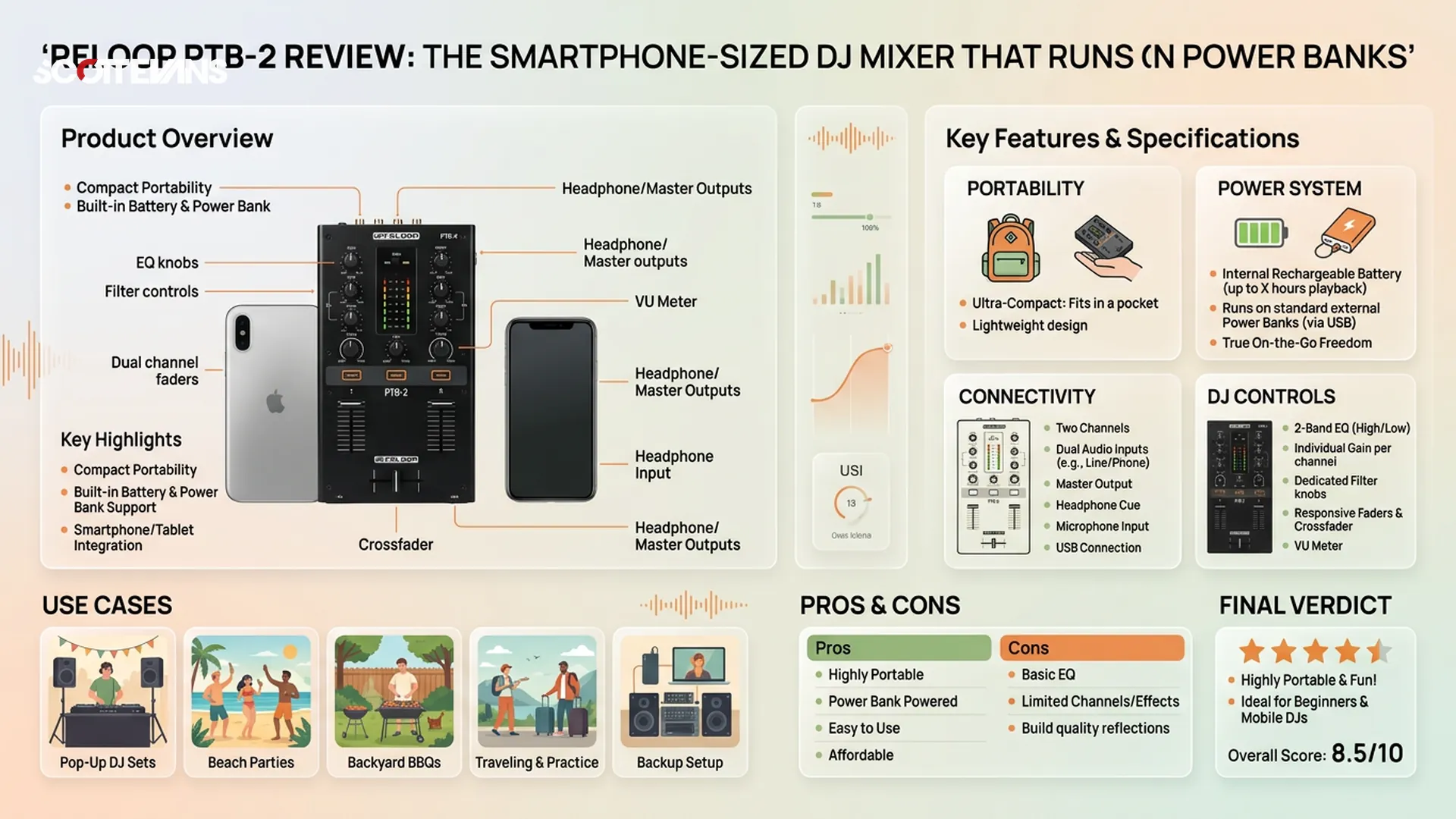
What Makes the PTB-2 a Game-Changer for Mobile DJs?
Have you ever wanted to scratch or mix vinyl in the park, at a beach, or in a hotel room without lugging a 10kg battle mixer and hunting for wall outlets? The PTB-2 addresses exactly this frustration. Reloop has essentially distilled the essential features of a professional scratch mixer into a form factor that weighs less than a standard laptop.
The mixer measures just 105mm x 200mm x 60mm. To put that in perspective, it is roughly the size of a paperback book. Yet despite this tiny footprint, you get two full channel strips with gain control, two-band EQ (treble and bass), and bipolar filters. The 45mm crossfader sits comfortably between the channels with adjustable curve control and reverse switching.
Tempo & Timing: tap tempo
Tap a manual tempo estimate, then use the same BPM for effects and phrases
Why does the crossfader matter so much? For scratch DJs, the fader is the instrument. Reloop made the smart move of making this RMX Innofader-compatible, meaning when you eventually wear out the stock fader (or if you just want that premium feel), you can upgrade to a professional magnetic crossfader without replacing the entire unit.
Understanding the Power Revolution: Why USB-C Changes Everything
Here is where the PTB-2 truly separates itself from the competition. The mixer draws only 2.2 watts of power. This is revolutionary because it means you can power professional-grade audio processing from a standard USB power bank, your laptop, or even a tablet. No more hunting for wall outlets or carrying heavy power bricks.
The implications here are massive for gigging DJs. You can literally perform a full DVS set in the middle of a field with just the PTB-2, two portable turntables, a power bank, and your phone. The mixer features dual USB-C ports: one for power input and one that can actually charge your mobile devices while you play.
Pro Tip
DVS Demystified: How the PTB-2 Unlocks Digital Vinyl
Digital Vinyl Systems (DVS) allow you to control digital audio files using standard turntables and special timecode records. The PTB-2 features a built-in 4×4 USB-C audio interface (four inputs, four outputs) that automatically unlocks DVS functionality in Algoriddim Djay Pro when connected.
What makes this special? You do not need a paid subscription to Djay Pro to use DVS with this mixer. Simply connect the PTB-2 and the software recognizes the hardware, enabling DVS mode immediately. This saves you roughly $10-15 monthly compared to subscription-dependent setups.
The mixer also plays nicely with other DVS software. While Reloop markets the Djay Pro integration heavily, the class-compliant audio interface should work seamlessly with Traktor, VirtualDJ, and open-source alternatives like Mixxx. Any software that supports standard Core Audio or ASIO drivers without requiring proprietary hardware authorization should recognize the PTB-2 immediately.
The Bluetooth and AUX Channel: Your Secret Weapon
The "+1" in the 2+1 channel configuration refers to the third channel that handles Bluetooth and auxiliary inputs via a 3.5mm jack. This is not just an afterthought; it is a legitimate performance tool.
Imagine this scenario: You are playing a mobile gig using DVS through channels 1 and 2. Suddenly, someone wants to play a track from their phone that is not in your library. Instead of messing with cables or disrupting your setup, you simply pair their device via Bluetooth to channel 3 and mix it in using the dedicated level control.
Alternatively, you can use this channel for streaming backing tracks, drum loops, or acapellas from a secondary device while you scratch or mix on the main channels. The Bluetooth implementation features low-latency connectivity, meaning you can actually use it for rhythm elements without noticeable delay issues.
Real-World Setup Scenarios
Let us walk through how you might actually use this mixer in different contexts. Each scenario highlights why the PTB-2 fills a unique niche in the DJ ecosystem.
The Park Jam Setup
You arrive at the park with a backpack containing the PTB-2, two 7-inch portable turntables (like the Reloop Spin), a 20,000mAh power bank, and your phone. You connect everything via USB-C, drop the needle on timecode records, and you are scratching within two minutes of arriving. Total weight: under 5kg including speakers.
The Hotel Room Practice Rig
Traveling for work but need to practice your scratches? The PTB-2 plus a single portable turntable and your laptop creates a minimal setup that will not disturb neighboring rooms. The small footprint means you can set up on a desk without moving furniture.
The Backup Emergency Mixer
Even if you primarily use a full-sized club mixer, keeping a PTB-2 in your gig bag provides insurance against equipment failure. If the venue's mixer dies, you can route your main decks through the PTB-2 and keep the party going.
| Feature | Reloop PTB-2 | Traditional Battle Mixer | Compact Analog Mixer |
|---|---|---|---|
| Weight | 700g | 4-6kg | 1.5-2kg |
| Power Requirements | USB-C (2.2W) | AC Mains (15-30W) | AC Mains or 9V Adapter |
| DVS Support | Native (No subscription) | Requires external interface | None |
| Bluetooth Input | Yes | Rare | No |
| Crossfader Upgrade Path | Innofader-compatible | Varies by model | Rarely upgradeable |
| Price Range | €249 | €800-2000+ | €100-300 |
Audio Quality and Build Considerations
When a mixer shrinks this small, audio quality concerns naturally arise. The PTB-2 uses a 24-bit/48kHz audio interface, which exceeds CD quality and matches professional standards. The phono preamps provide adequate gain for most modern cartridges, though extremely low-output vintage cartridges might require additional boost.
The two-band EQ (high and low) with bipolar filter is somewhat limited compared to three or four-band mixers, but this is an acceptable compromise for the form factor. For scratching and basic mixing, two bands provide sufficient tonal control. The bipolar filter (which can act as either high-pass or low-pass depending on direction) adds creative possibilities for transitions.
One limitation to note: the mixer does not include built-in effects or a hardware sampler. You will need to handle all effects processing in software when using DVS, or use external pedals if running analog sources.
Who Should Buy the PTB-2?
This mixer is not trying to replace your Pioneer DJM-S11 or Rane Seventy-Two. Instead, it serves specific use cases that larger mixers cannot address.
Perfect for:
- Portablists building ultra-mobile scratch rigs
- Mobile DJs needing backup equipment
- Bedroom DJs with limited space
- Travelers who practice in hotel rooms
- DJs transitioning to DVS who want an affordable entry point
Look elsewhere if:
- You need four-channel mixing capability
- You require built-in hardware effects
- You prefer three or four-band EQs for complex blending
- You need XLR outputs for direct PA connection (the PTB-2 uses RCA only)
Power Management Tips for Outdoor Gigs
Since the PTB-2 relies entirely on external USB power for mobile use, understanding power management becomes crucial for reliability. A standard 10,000mAh power bank can theoretically run this mixer for approximately 18-20 hours continuously, given the 2.2W draw.
However, cold weather affects lithium batteries significantly. If you are performing outdoors in winter, keep your power bank in an inside pocket until setup time, and consider bringing a backup. Also, while the PTB-2 can charge your phone through the second USB-C port, doing so will reduce your battery life proportionally. For critical gigs, dedicate one power bank to the mixer and use a separate one for your phone or tablet.
Using our DJ AI Suite, you can actually calculate exact power requirements for your specific gig duration and backup redundancy needs.
The Verdict: Is the PTB-2 Worth €249?
At €249, the PTB-2 sits in an interesting price position. It is more expensive than basic two-channel analog mixers but significantly cheaper than professional DVS-enabled battle mixers. When you factor in that you do not need to purchase a separate audio interface (which typically costs €100-200) and you get Bluetooth connectivity plus true portability, the value proposition becomes clear.
For DJs committed to the portablism movement or those who frequently play mobile gigs, this mixer pays for itself in convenience alone. The ability to perform a proper DVS set literally anywhere without mains power opens creative possibilities that were previously impossible without compromising on sound quality or features.
The build quality feels solid despite the light weight, and the Innofader compatibility means this is an investment that can grow with your skills. While the lack of built-in battery might disappoint some (requiring you to supply your own power bank), this actually future-proofs the device as battery technology improves.
If you have been waiting for a reason to explore DVS or need to downsize your mobile rig without losing capability, the PTB-2 deserves serious consideration. It represents a new category of mixer: the true grab-and-go professional tool.
Frequently Asked Questions
The PTB-2 functions as a standard audio interface with Serato DJ Pro, but it does not unlock Serato's DVS functionality natively. Serato requires specific hardware certification for DVS support. However, you can use the mixer as your audio device for Serato's internal mixing mode, or use the phono inputs for traditional vinyl control without digital integration.
Key Takeaways
- Core takeaway: Reloop ptb review smartphone works best with a repeatable prep-to-performance workflow.
- Prioritize one stable process before adding extra tools or plugins.
- Track outcomes after each set and keep only steps that improve reliability and results.