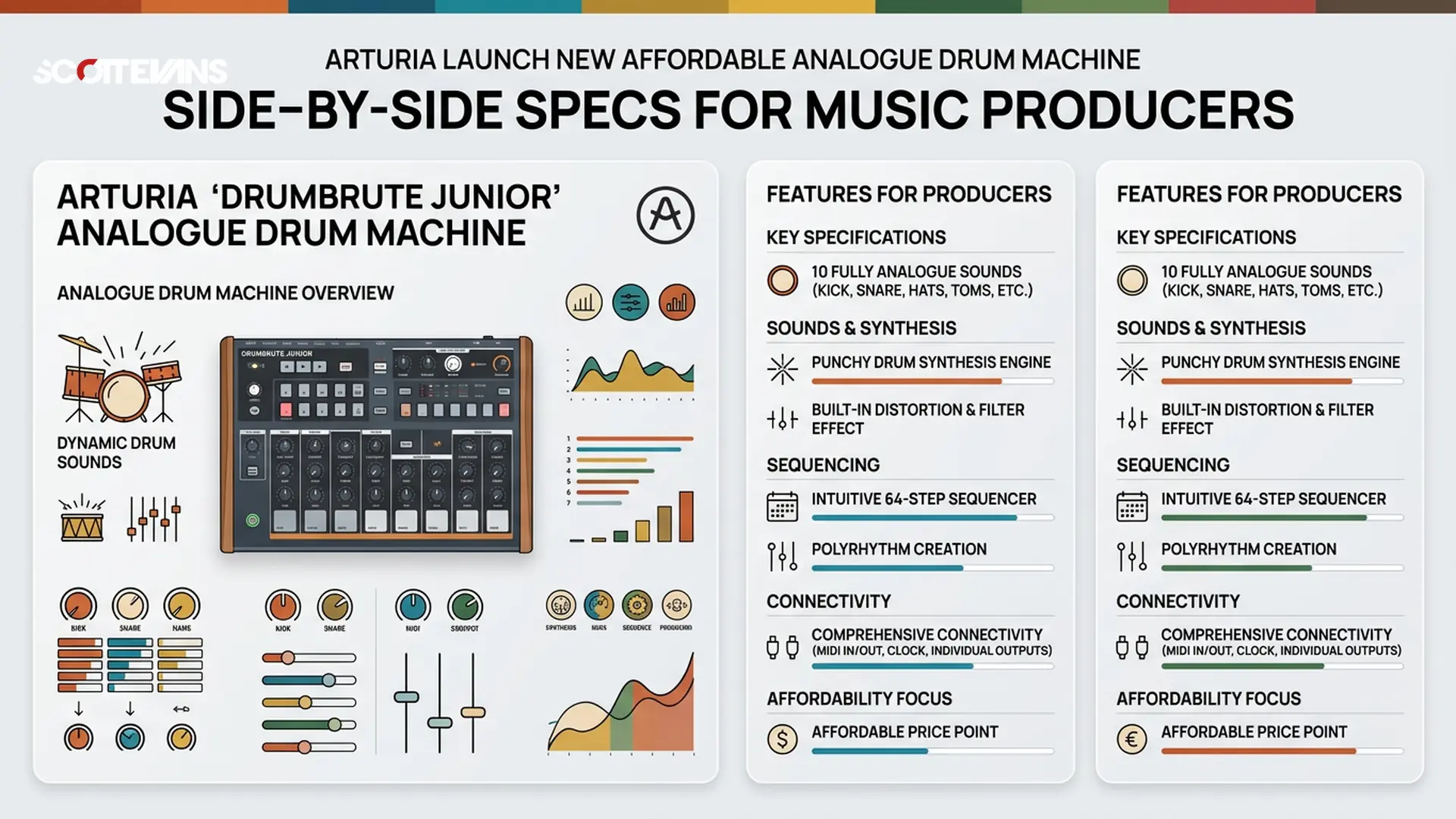
Arturia DrumBrute Impact Deep Dive: Analog Drum Power for Modern Producers - Scott Evans DJ
Why Hardware Drum Machines Still Matter in Digital DJing
Have you ever felt like your DJ sets lack that organic punch when transitioning between digital tracks? You are not alone. Many professional DJs are rediscovering hardware drum machines as the secret weapon for adding live energy to performances. The Arturia DrumBrute Impact arrives at a perfect moment when producers and performers seek tactile, analog warmth without sacrificing modern workflow flexibility.
This is not just another drum machine. At $349, Arturia has positioned the DrumBrute Impact as an accessible entry point into true analog synthesis. Unlike software plugins that emulate analog behavior, this hardware generates sound through actual voltage-controlled circuits. The result is a living, breathing rhythmic foundation that sits differently in a mix compared to digital samples.
Tempo & Timing: tap tempo
Tap a manual tempo estimate, then use the same BPM for effects and phrases
Breaking Down the Sound Architecture
What exactly makes the DrumBrute Impact sonically unique? The unit houses 10 distinct drum voices, each crafted through analog circuitry rather than sample playback. This means every hit has microscopic variations in pitch, decay, and timbre, creating that coveted "alive" feeling that listeners subconsciously respond to.
The kick drum delivers a tight, punchy thump that cuts through dense mixes without overwhelming the low end. The snare offers both tone and noise components, allowing you to dial in everything from tight 808-style snaps to gritty industrial cracks. But the real star is the new FM Drum voice.
Understanding the FM Drum Innovation
FM synthesis might sound complex, but think of it as one waveform modulating another to create harmonic overtones. The DrumBrute Impact's FM Drum uses this principle to generate metallic, bell-like tones or harsh industrial percussion that self-modulates. This means the sound evolves as it decays, creating textures impossible to achieve with simple subtractive synthesis.
For DJs who produce their own edits, this FM Drum opens doors to creating unique transitional elements. Imagine dropping a fill that sounds like crushed glass morphing into a sub bass hit. That is the kind of sonic territory we are exploring here.
Pro Tip
Sequencing Power for Complex Rhythms
The 16-step sequencer might look standard on the surface, but Arturia has hidden serious depth beneath those rubber buttons. Each of the 16 steps can hold accented notes, and the polyrhythm functionality allows different tracks to run at different lengths simultaneously.
What does this mean practically? You can program a kick drum to loop every 16 steps while your hi-hats cycle through a 15-step pattern. The resulting rhythm never quite repeats the same way, generating the "humanized" feel that separates mechanical beats from groovy ones.
The sequencer also features a Swing control that affects the entire pattern, plus individual Swing settings per instrument. This allows you to push the hi-hats slightly behind the beat while keeping the kick locked to the grid, a technique used in classic hip hop and house production.
Connectivity That Makes Sense for Performers
Here is where the DrumBrute Impact proves it understands modern workflow needs. The four individual outputs (Kick, Snare, Hi Hats, and FM Drum) allow you to process each element separately through your mixer or audio interface.
Why does this matter for DJs? When you are layering drum machine patterns over existing tracks, you need surgical control. Send the kick to a dedicated channel with heavy compression to make it punch through the mix. Route the FM Drum through a delay pedal for spatial effects. Keep the hi-hats dry and crisp on another channel. This multitrack approach transforms the DrumBrute Impact from a simple beat box into a live mixing instrument.
The unit also includes MIDI in/out, Clock in/out for syncing with modular gear, and USB connectivity for integration with your DAW. Whether you are running Ableton Live sessions or spinning vinyl, the DrumBrute Impact locks to your tempo source reliably.
| Feature | DrumBrute Impact | Typical Budget Drum Machine | Premium Analog Units |
|---|---|---|---|
| Price | $349 | $200-400 | $600-1500 |
| Individual Outputs | 4 | 1-2 | 8-12 |
| FM Synthesis | Yes (dedicated voice) | Rare | Sometimes |
| Polyrhythm Sequencer | Yes | No | Sometimes |
| Portability | Compact (1.6kg) | Varies | Often heavy |
| True Analog | Yes | Often hybrid | Yes |
The Colour Feature: Sonic Character on Demand
Arturia has implemented something called the Colour feature across the DrumBrute Impact's sound palette. This is not a simple filter or EQ. Instead, it applies specific analog processing tailored to each drum voice.
On the kick drum, Colour might add saturation and subharmonic content. On the snare, it could introduce noise or alter the decay envelope. The hi-hats get brighter and more metallic when Colour is engaged. This gives you two distinct versions of every sound without menu diving or complex modulation routing.
For live performers, this is gold. You can program a basic pattern, then use the Colour buttons to create variations on the fly. Drop the Colour out during verses for a stripped-back feel, then slam it back in for choruses or drops. It is like having a remix of your beat available instantly.
Integrating with Your DJ Workflow
How do you actually use this thing during a gig? Let us walk through a practical scenario. You are playing a house set and want to add live percussion over a track that feels too static.
First, sync the DrumBrute Impact to your DJ software using MIDI clock or tap tempo. Program a simple kick and clap pattern that complements the track's existing rhythm. Use the individual outputs to blend the analog drums with the digital audio. As the track builds, introduce the FM Drum with Colour engaged for a metallic riser effect. When the drop hits, mute the drum machine and let the original track take over.
This hybrid approach combines the best of both worlds: the infinite flexibility of digital DJing with the tactile warmth of analog hardware.
Value Analysis: Is $349 the Sweet Spot?
Let us talk numbers. At $349, the DrumBrute Impact sits in an interesting market position. It is more expensive than entry-level digital groove boxes but significantly cheaper than vintage analog drum machines or high-end modern equivalents like the Roland TR-8S or Elektron Analog Rytm.
What you get for that price is genuine analog circuitry, professional connectivity, and a sequencer sophisticated enough for complex compositions. The build quality feels substantial despite the compact size, with those chunky rubber pads responding satisfyingly to finger drumming.
For DJs looking to add production elements to their sets without investing in a full studio, this represents a low-risk entry point. It is also compact enough (weighing just 1.6kg) to toss in a backpack alongside your headphones and USB sticks.
Pro Tip
Creative Possibilities Beyond Traditional Beats
The DrumBrute Impact rewards experimentation. Try running the individual outputs through guitar pedals. Use the randomize function on the sequencer to generate unexpected patterns, then tweak them into usable grooves. Sample the outputs into your DJ software to create unique drum kits that no other DJ possesses.
The polyrhythm capabilities also lend themselves to genres beyond four-on-the-floor house. Try setting up complex 7/8 or 5/4 patterns for techno experiments, or use the FM Drum to create melodic sequences by adjusting the pitch per step.
Frequently Asked Questions
Yes, absolutely. While it offers depth for experienced producers, the front-panel controls are intuitive and immediate. You can start making beats within minutes of unboxing without reading the manual. The $349 price point also makes it less intimidating for newcomers compared to $1000+ alternatives.
Key Takeaways
- Core takeaway: Arturia launch new affordable works best with a repeatable prep-to-performance workflow.
- Prioritize one stable process before adding extra tools or plugins.
- Track outcomes after each set and keep only steps that improve reliability and results.