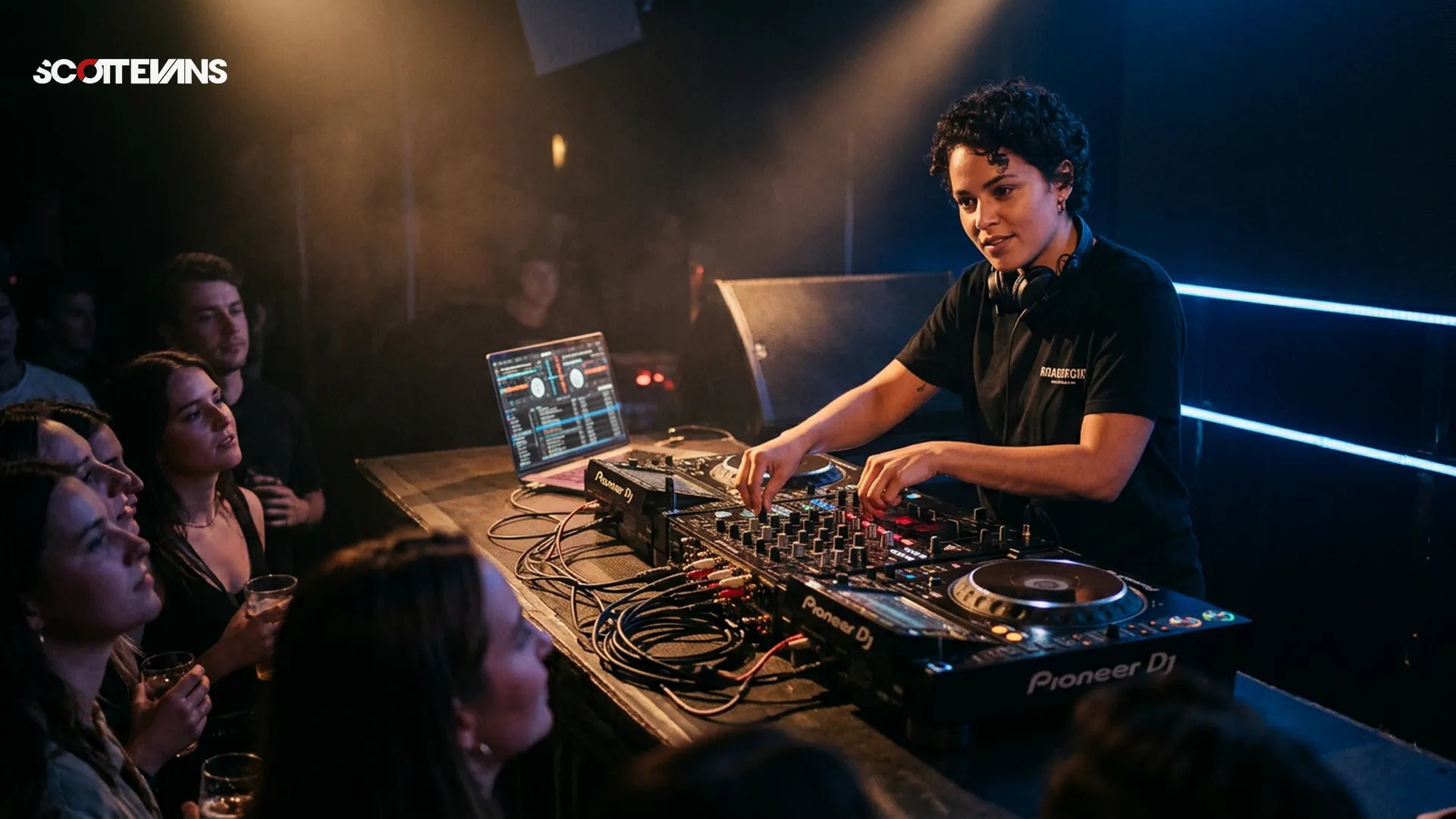
If you have ever struggled to beatmatch two tracks manually or spent hours organizing playlists for a gig, you are not alone. AI DJ tools represent the next evolution in music technology, combining traditional DJ software with artificial intelligence to handle the technical heavy lifting.
These platforms go beyond simple auto-sync functions. Modern AI DJ assistants analyze audio characteristics like tempo, key signature, energy levels, and even crowd response data to make intelligent mixing decisions. They can suggest the next track based on what is currently playing, automatically adjust EQ settings for smoother transitions, and isolate individual elements like vocals or drums for creative remixing.
For working DJs, this means less time staring at waveforms and more time reading the room. For beginners, it lowers the barrier to entry significantly. You no longer need to understand complex music theory or have perfect pitch to create harmonically compatible sets. Our free BPM Calculator and Key Finder tools on scottevansdj.com complement these AI platforms perfectly, giving you manual control when you want it and automated assistance when you need it.
How Artificial Intelligence Is Transforming the DJ Booth
The integration of AI into DJing is not about replacing human creativity. It is about amplifying it. Here is how these technologies are changing what happens behind the decks.
Automated Beatmatching and Tempo Analysis
Remember the days of manually nudging vinyl to get two tracks perfectly aligned? Even digital DJs know the stress of beatmatching under pressure. AI tools now analyze the transient patterns and rhythm structures of your tracks instantly, locking beats together with mathematical precision.
This does not mean you should abandon learning manual beatmatching entirely. Understanding the fundamentals makes you a better DJ. However, when you are managing four decks, effects, and crowd interaction simultaneously, having AI handle the grid alignment lets you focus on the artistic elements of your mix.
Tempo & Timing: tap tempo
Tap a manual tempo estimate, then use the same BPM for effects and phrases
Try our BPM Calculator above to analyze the tempo of any track before loading it into your AI DJ software. This helps you verify that the automated detection matches your ears, especially with tracks that have complex rhythmic patterns or live drumming that might confuse basic algorithms.
Harmonic Mixing Made Simple
One of the most powerful applications of AI in DJing is harmonic mixing. Traditional DJs needed to memorize the Circle of Fifths or use Camelot notation wheels to find tracks in compatible musical keys. Modern AI tools analyze the tonal center of every track in your library and visually indicate which songs will blend musically versus which ones will clash.
Use our Key Finder tool to double-check key detection results from your AI software. While algorithms are getting incredibly accurate, acoustic variations and remastered versions can sometimes return different key readings. Trust your ears, but use the technology as a safety net.
The 7 Best AI DJ Tools for Seamless Mixes in 2026
After testing dozens of platforms in both club environments and studio sessions, here are the standout AI DJ tools that actually deliver on their promises.
Mixonset: The Playlist Intelligence Specialist
Mixonset has carved out a unique niche by focusing specifically on intelligent playlist curation and song shortening. Unlike traditional DJ software that assumes you want to play full tracks, Mixonset analyzes the "best parts" of songs using AI detection of chorus drops, energy peaks, and vocal sections.
The Smart Mix function is particularly impressive for mobile DJs and playlist creators. It examines your entire selected catalog and arranges tracks in an order that maintains energy flow while ensuring harmonic compatibility. If you are creating a playlist for a dinner party that transitions into a dance party, Mixonset can automate that progression without jarring key changes or tempo jumps.
The Highlight Mode deserves special mention. It identifies the most engaging 60-90 seconds of each track, allowing you to create high-impact mixes that keep momentum flowing. This is perfect for short attention span environments like TikTok livestreams or opening sets where you want to showcase variety without losing the crowd.
DJ Studio: Harmonic Precision for Purists
DJ Studio takes a different approach, positioning itself as the choice for DJs who care deeply about musical theory and harmonic mixing. The software does not just detect keys; it analyzes the emotional quality of chord progressions and suggests transitions that maintain or appropriately shift the mood of your set.
The real-time analysis engine is remarkably fast. Load a track, and within seconds you have BPM, key, camelot notation, and energy level data. The AI goes further by suggesting not just what key works next, but what specific chord changes will create tension or release in your mix.
For producers who DJ, DJ Studio offers unique stem separation that actually works. You can isolate drums, bass, vocals, or melodies with surprising clarity, allowing for live mashups that previously required hours of studio preparation. The integration with streaming services means you can test these remix ideas with tracks you do not even own yet, purchasing only what makes it into your final set.
Empress: The Creative Remix Engine
Empress stands out for its focus on personalized remixing and audio characteristic analysis. While other tools focus on transitions between tracks, Empress treats your entire library as a pool of elements to be recombined.
The AI examines spectral content, transient response, and rhythmic patterns to suggest mashup opportunities you might never have considered. It can automatically time-stretch acapellas over instrumentals with different original tempos while maintaining pitch integrity.
The playlist curation features use collaborative filtering similar to Netflix recommendations, but applied to DJ sets. If you tell Empress that Track A and Track B worked well together in your last gig, it learns your personal mixing style and finds other combinations with similar energy relationships. Over time, it builds a profile of your taste that becomes scarily accurate at predicting what you will want to play next.
VirtualDJ Pro: The Industry Standard Evolved
VirtualDJ has been around for decades, but recent AI implementations have transformed it from a beginner tool into a professional powerhouse. The modern VirtualDJ Pro uses machine learning for what they call "ModernEQ" - an intelligent equalizer that separates frequencies more musically than traditional three or four-band EQs.
The track separation technology here is among the best available commercially. You can remove vocals from tracks in real-time to create instant instrumentals for mixing, or isolate the bassline to create transitions where the rhythm continues but the harmonic content changes. This works surprisingly well even on complex, mastered stereo files where traditional phase cancellation fails.
Hardware compatibility remains VirtualDJ's secret weapon. The software recognizes virtually every DJ controller on the market automatically, and the AI maps the most logical functions to your available knobs and faders based on the specific controller layout. This means less time configuring MIDI mappings and more time actually mixing.
Rekordbox: Pioneer’s AI Ecosystem
Pioneer DJ's Rekordbox has embraced AI through its Cloud Analysis and Intelligent Curation features. When you upload tracks to Rekordbox Cloud, Pioneer's servers analyze them using more powerful algorithms than your local computer could run, returning detailed metadata including mood descriptors, danceability scores, and vocal presence indicators.
The track separation in Rekordbox 6 and 7 allows for live performances where you can manipulate individual elements of a song without having the original stems. This opens up possibilities for live remixing of classic tracks that you cannot legally obtain multitracks for.
For mobile DJs, the AI playlist generation can create hours of compatible music based on a single "seed" track. Tell Rekordbox you want a set that feels like "September" by Earth, Wind & Fire, and it will find tracks with similar BPM, key, rhythmic complexity, and era-appropriate energy levels.
Serato DJ Pro: The Reliable Workhorse Gets Smarter
Serato has taken a more conservative approach to AI integration, focusing on stability and reliability while adding smart features that enhance rather than replace traditional DJ skills. The Pitch 'n Time algorithm remains the industry standard for time-stretching, and recent updates have added AI-assisted key detection that rivals dedicated analysis software.
The Smart Sync function goes beyond simple beatmatching by analyzing the phrasing of tracks. It knows not just where the beat falls, but where the bars, phrases, and musical sections begin, ensuring that your drops align perfectly even when mixing between genres with different rhythmic structures.
Serato's AI shines in its library management. The software can automatically suggest crates and playlists based on the gig type you tell it you are playing. Input "wedding reception" and it suggests appropriate moments for first dances, bouquet tosses, and high-energy dancing, complete with crossfade recommendations.
Riffusion: Generative AI for Original Content
Riffusion represents the wild frontier of AI DJing - generative music creation. Unlike the other tools that manipulate existing tracks, Riffusion creates entirely new music based on text prompts or style references.
You can type "melodic techno at 128 BPM with ethereal pads and driving bass" and Riffusion generates unique loops that have never been heard before. For DJs who produce their own edits, this provides royalty-free elements to layer into sets without clearing samples.
The real-time style transfer is particularly useful for mobile DJs who need to cater to diverse crowds. You can take a current pop hit and have Riffusion reimagine it as a reggae track, jazz piece, or ambient soundscape, creating unique versions that no other DJ can play.
Pro Tips for Integrating AI Into Your Workflow
After years of testing these tools in live environments, here are some practical strategies for making AI work for you rather than against you.
Harmonic Mixing Guide
Find compatible keys using the Camelot wheel
Pro Tip
Start by using AI for library organization rather than performance. Let these tools analyze your keys, BPMs, and energy levels during the week, but perform manually on the weekend. This gives you the benefits of organized metadata while maintaining your artistic voice.
When using stem separation features, always check the audio quality on the venue's sound system before the crowd arrives. AI separation can sometimes introduce artifacts that are not noticeable on headphones but become obvious on large PA systems, particularly in the high-frequency range.
If you are using AI-generated transitions or automated mixing, practice your stage presence. Audiences come to see a performance, not a computer playlist. Use the time saved by automation to engage with the crowd, work the microphone, or perform on drum pads and other controllers.
The Future of AI in DJing
Looking ahead, we are seeing the early stages of predictive DJing, where AI analyzes crowd response through microphone input and camera feeds to suggest track changes in real-time. Imagine software that notices the dance floor energy dropping and automatically suggests the perfect track to bring it back up, or recognizes when the crowd is singing along and extends the chorus automatically.
We are also approaching fully generative DJ sets, where AI composes transitions on the fly rather than just blending pre-existing tracks. This raises interesting questions about authorship and copyright, but opens possibilities for truly infinite sets that never repeat.
For now, the smart move is to treat AI as a collaborative partner. Use our DJ AI Suite for advanced track analysis and preparation, then deploy Set-to-Content to turn your recorded mixes into social media content automatically. The technology should handle the tedious aspects of the job while you focus on the art.
Frequently Asked Questions
Not at all. While AI can handle technical tasks like beatmatching and key detection, it cannot read a room, understand cultural context, or create the emotional journey that makes a great DJ set memorable. The best DJs use AI to free up mental bandwidth for crowd reading and creative performance. Think of it like automatic transmission in a car - it helps you get from point A to B, but you still need to know how to drive and choose the destination.
Key Takeaways
- Core takeaway: AI DJ tools works best with a repeatable prep-to-performance workflow.
- Prioritize one stable process before adding extra tools or plugins.
- Track outcomes after each set and keep only steps that improve reliability and results.